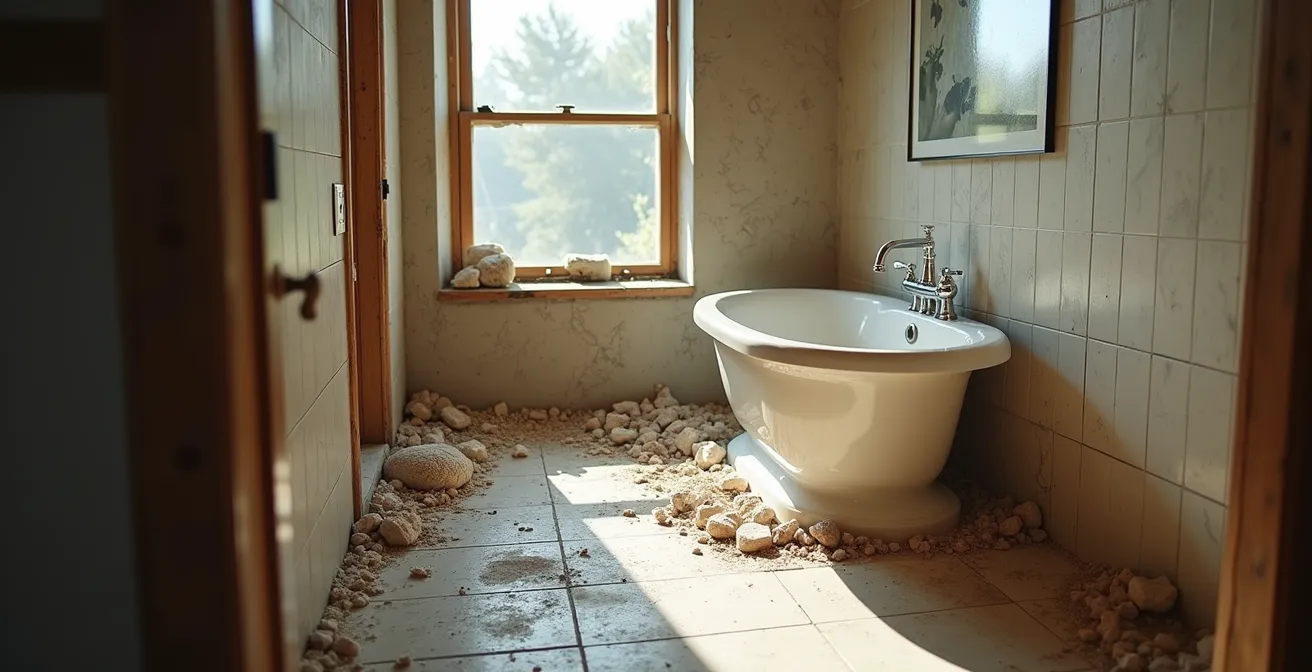
Every bathroom renovation follows a deceptively predictable pattern: the most expensive failures don’t announce themselves during demolition or installation. They embed themselves quietly during the planning phase, compounding silently through each subsequent decision until the final invoice reveals damage already done.
Understanding bathroom renovation cost escalation requires shifting focus from isolated mistakes to the cascade effect they create. A skipped moisture assessment doesn’t just risk mold remediation costs—it invalidates every design decision made afterward. A verbal approval for a minor change doesn’t just add one line item—it establishes a precedent that erodes budget discipline across the entire project.
The renovation industry has conditioned homeowners to expect the wrong problems. Standard advice warns against cheap materials and unlicensed contractors, yet the costliest disasters originate earlier: in the diagnostic failures that guarantee structural surprises, the decision sequencing that locks in expensive compromises, and the communication gaps that transform controllable issues into budget-destroying crises. Each mistake category operates as a decision gate—pass through it uninformed, and costs compound irreversibly on the other side.
Bathroom Renovation Budget Protection in 5 Critical Gates
- Pre-renovation diagnostics prevent five-figure structural surprises that derail projects mid-execution
- Design decision sequencing determines whether you maintain flexibility or face costly irreversible compromises
- Contractor communication protocols stop silent scope creep before it accumulates into thousands of undocumented charges
- Proactive structural investigation eliminates mid-project discoveries that force complete redesigns
- Long-term value planning ensures today’s savings don’t become tomorrow’s devaluation at resale
Pre-Renovation Diagnostic Failures That Cascade Into Five-Figure Overruns
The bathroom renovation industry perpetuates a dangerous myth: that the project truly begins when demolition starts. In reality, the costliest decisions occur weeks earlier, during the assessment phase that most homeowners either skip entirely or perform superficially. These diagnostic failures don’t reveal themselves as line items on initial estimates—they emerge mid-project as change orders that double budgets.
Failing to precisely map existing plumbing and electrical routing before finalizing design plans represents the single most common pre-renovation failure. Homeowners commit to tile patterns, fixture placements, and vanity configurations based on assumptions about where supply lines and drains actually terminate. When demolition exposes reality—a drain positioned three inches from where plans assumed, a supply line running directly through the planned shower niche—the options narrow to expensive reroutings or design compromises that haunt the space for decades.
The financial impact compounds because discovery timing coincides with peak commitment. Materials are ordered, contractors are scheduled, and timelines are fixed. What should have been a $200 pre-construction camera inspection becomes a $3,500 emergency plumbing modification, plus delays that trigger penalty clauses or force homeowners into temporary housing arrangements.
Subfloor integrity and drainage slope testing suffers from similar negligence. The assumption that existing flooring conceals adequate substrate proves catastrophically wrong in bathrooms subjected to years of minor leaks and humidity exposure. A labor costs account for up to 60% of total bathroom remodel budgets, and when tile installation reveals subfloor rot or improper slope, that labor must be performed twice—first to remove newly installed materials, then to rebuild the foundation, then to reinstall.
| Assessment Type | Minor Remodel | Major Renovation | Full Gut |
|---|---|---|---|
| Shutoff Valve Testing | Required | Critical | Critical |
| Structural Evaluation | Optional | Required | Critical |
| Moisture Testing | Recommended | Required | Critical |
| Permit Research | Sometimes | Usually | Always |
Mold and moisture assessment behind existing walls represents another pre-renovation diagnostic that homeowners defer until demolition forces the issue. The logic seems sound: why pay for invasive testing when demolition will reveal everything anyway? The answer lies in budget allocation and contractor scheduling. Discovering extensive mold remediation needs after work begins triggers emergency abatement protocols, specialized contractor mobilization, and timeline extensions that cascade through every subsequent trade.
The hidden cost multiplier emerges from jurisdictional requirements. Many municipalities mandate that once mold exceeding certain thresholds is disturbed, remediation must follow specific protocols before any other work continues. A bathroom renovation transforms overnight into an environmental remediation project, complete with containment barriers, air quality testing, and disposal documentation. What began as a cosmetic update now carries remediation costs that often exceed the original renovation budget.
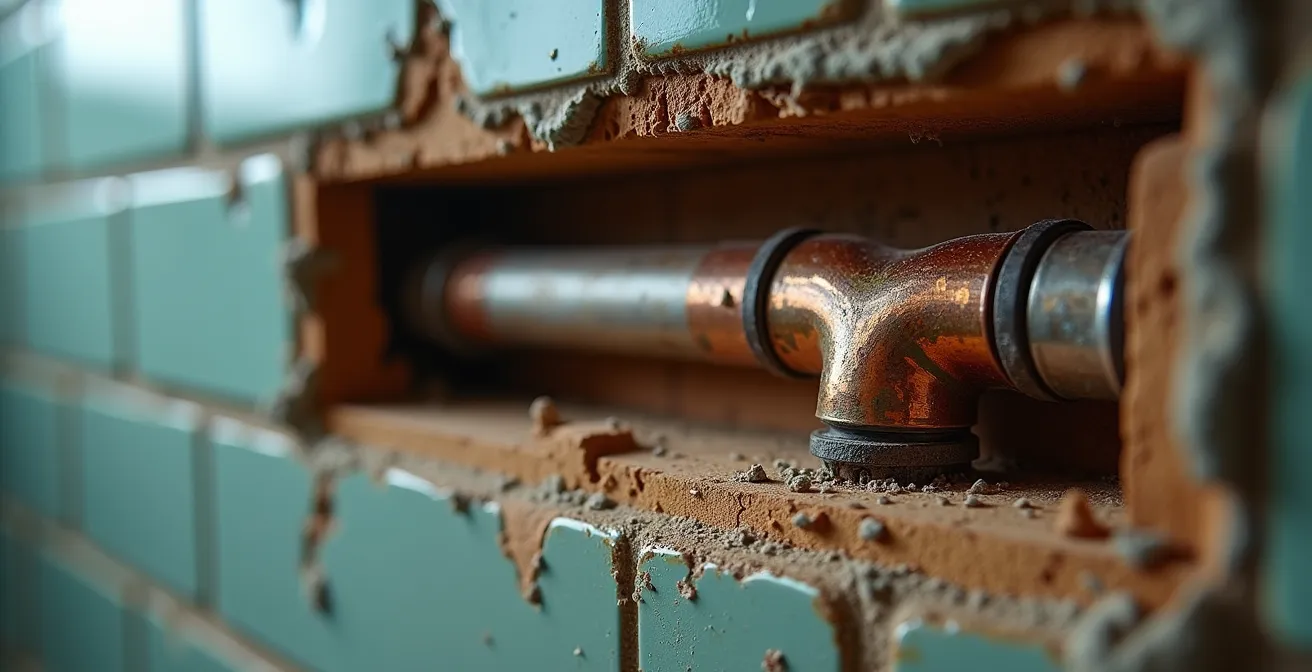
Clearance requirement calculations for modern fixtures represent the most underestimated diagnostic failure. Floating vanities, wall-mounted toilets, and barrier-free showers have transformed bathroom aesthetics, but each imposes structural demands that vintage construction never anticipated. Wall-mounted toilets require concealed carrier systems with specific blocking and clearance behind walls. Curbless showers demand precise floor elevation relationships that often necessitate lowering drain lines or raising adjacent room floors.
These spatial requirements interact with existing conditions in ways that design software cannot predict. A planned floating vanity that looks perfect in renderings becomes impossible when demolition reveals that the wall conceals a vent stack exactly where the carrier must install. The choice narrows to relocating the vent—a multi-thousand-dollar structural modification—or abandoning the design centerpiece and selecting a conventional vanity that no longer coordinates with the tile, lighting, and mirror already purchased.
Design Sequencing Mistakes That Lock You Into Costly Compromises
Poor initial diagnostics create informational gaps, but even with perfect assessment data, homeowners destroy budgets through decision sequencing errors. The renovation industry rarely acknowledges that design choices possess inherent ordering requirements—make decisions in the wrong sequence, and each subsequent choice becomes progressively more constrained and expensive.
Selecting tile patterns and ordering materials before confirming exact plumbing rough-in locations exemplifies this sequencing failure. Tile represents both an aesthetic and a technical commitment. Once homeowners finalize patterns—particularly complex layouts involving herringbone, hexagons, or custom mosaics—the grout line locations, tile module dimensions, and visual focal points become fixed. These geometric commitments then dictate where fixtures can install without creating awkward cuts or pattern interruptions.
The sequencing error manifests when plumbing rough-in occurs after tile purchase. Plumbers work within code-mandated tolerances that allow drain and supply placement to vary by several inches. When tile patterns haven’t been finalized, this flexibility poses no problem—the plumber centers drains optimally, and tile layouts adapt. Reverse the sequence, and the plumber must either match existing tile geometry exactly—requiring custom blocking and potentially code-variance situations—or install to standard positions that force tile layouts into expensive custom cutting patterns.
Critical Design Sequence Order
- Finalize plumbing and electrical rough-in locations before any material orders
- Confirm exact drain and supply line positions before selecting vanity dimensions
- Verify structural framing and joist locations before choosing fixtures
- Complete moisture and mold assessment before finalizing tile patterns
- Test all shutoff valves before beginning any demolition work
Custom vanity commitments before drain verification follow similar logic but impose even steeper penalties. Custom cabinetry operates on lead times measured in weeks and deposits that become non-refundable once fabrication begins. Homeowners measuring existing vanity dimensions assume replacement units can match those footprints, overlooking that drain and supply positions dictate sink placement, which in turn determines where cabinet internals can accommodate plumbing penetrations.
When demolition reveals drain positions offset from assumptions, the custom vanity becomes incompatible. The fabricator cannot modify internal configurations without restarting the build process. Homeowners face choices between expensive plumbing relocations to match cabinetry, reordering vanities with months of additional delay, or accepting field-modified solutions that compromise both function and aesthetics.
Shower system orders before structural framing verification create particularly expensive sequencing traps. Modern thermostatic valves, digital controls, and multi-head systems require specific rough-in dimensions and backing support. Manufacturers provide detailed installation specifications, and homeowners order complete systems based on design renderings showing valve placements at aesthetically ideal heights and positions.
Structural reality rarely cooperates. Ceiling joists, wall studs, and existing plumbing vents occupy space with geometric indifference to aesthetic preferences. The thermostatic valve that renders beautifully centered on the shower wall requires installation exactly where a vent stack penetrates. The rainfall head positioned for optimal coverage demands ceiling blocking where joist spacing makes mounting impossible without structural reinforcement. Each conflict forces expensive resolutions: reframing walls, relocating vents, adding supplementary blocking, or abandoning the shower system entirely and restarting selection with months of lead time lost.
| Sequencing Error | Average Cost Impact | Time Delay |
|---|---|---|
| Tile ordered before plumbing finalized | $2,000-4,000 | 2-3 weeks |
| Custom vanity before drain verification | $3,000-5,000 | 3-4 weeks |
| Lighting before joist confirmation | $1,500-2,500 | 1-2 weeks |
| Shower system before framing check | $2,500-4,500 | 2-3 weeks |
Lighting fixture commitments before ceiling joist confirmation represent the final major sequencing failure. Recessed lighting, particularly in shower areas requiring IC-rated housings, demands precise joist bay positioning. Pendant lights over freestanding tubs need structural blocking for support. Homeowners selecting fixtures based on design impact rarely consider that installation feasibility depends entirely on framing that remains concealed until ceiling work begins.
The sequencing error compounds when fixtures arrive before framing exposure. Return windows close, restocking fees apply, and replacement options narrow as availability shifts. Even when returns remain possible, the design process restarts: new fixtures must coordinate with tile, paint, and hardware already committed, severely limiting options and often forcing aesthetic compromises that diminish the entire space.
Contractor Communication Gaps That Trigger Uncontrolled Scope Expansion
Design sequencing errors create technical constraints, but contractor communication failures transform manageable issues into budget catastrophes. The renovation industry’s reliance on verbal communication and informal approval processes enables a specific pattern of scope creep that homeowners rarely recognize until final billing reveals accumulated damage.
Verbal approvals for small changes represent the most insidious communication gap. During active construction, minor issues arise constantly: a tile cut that would look better adjusted slightly, a fixture position that could shift six inches for better symmetry, a lighting placement that makes more sense rotated. Contractors propose these adjustments verbally, often framing them as improvements included in their craftsmanship. Homeowners approve immediately, viewing the changes as minor refinements.
Each individual modification genuinely qualifies as small—fifteen minutes of additional labor here, thirty minutes of custom cutting there. The accumulation, however, follows mathematical inevitability. A project generating five such verbal approvals weekly over an eight-week timeline creates forty undocumented modifications. At conservative estimates of $75-150 per change in labor and material adjustment, the final invoice includes $3,000-6,000 in additions that homeowners never consciously authorized as budget items.
The communication failure lies not in the changes themselves but in the absence of written change order protocols. Professional project management requires that every scope modification, regardless of perceived scale, generates documentation showing the work description, cost impact, and timeline effect. This documentation serves dual purposes: it forces homeowners to evaluate each change as a discrete budget decision, and it prevents the cognitive disconnect between dozens of small approvals and their collective financial impact.

Ambiguous contract allowances without itemized specifications create another communication gap that manifests as billing disputes. Many renovation contracts include allowances for fixtures, tile, and finishes expressed as lump sums: “$3,500 tile allowance” or “$2,000 lighting allowance.” These figures establish budget expectations but rarely specify the exact products, quantities, or quality levels the allowance covers.
The gap emerges during selection. Homeowners interpret the tile allowance as covering their preferred 12×24 porcelain at $8 per square foot plus installation. The contractor calculated the allowance based on standard 8×10 ceramic at $4 per square foot. Both parties believe they communicated clearly. When actual selections exceed the allowance by $2,500, conflict becomes inevitable. The homeowner feels baited by an artificially low estimate; the contractor maintains the allowance was clearly specified and overages reflect client upgrade choices.
Professional specifications prevent this gap by itemizing every allowance component: exact square footages, quality grades, installation methods, and product examples that define the baseline. When homeowners select products exceeding specifications, the upgrade conversation occurs during selection—when alternatives remain available—rather than during billing, when positions have hardened and relationships have degraded.
Unclear boundaries between homeowner DIY tasks and contractor scope generate similar communication failures. Many homeowners attempt to reduce costs by performing demolition, painting, or finish work themselves. When contracts fail to specify exact handoff points, responsibility gaps emerge that create expensive inefficiencies and finger-pointing.
A homeowner commits to demolition but doesn’t understand that “demolition complete” includes hauling debris, protecting adjacent spaces, and cleaning surfaces for inspection. The contractor arrives expecting to begin framing but must first spend a day completing demolition tasks billed as extra work. Or the homeowner plans to paint but doesn’t realize the contractor’s schedule assumes painting occurs between rough inspection and tile installation. The delayed painting holds up the entire project, triggering contractor standby time charges and cascade delays through subsequent trades.
Missing decision-making protocols for mid-project discoveries represent the final critical communication gap. Bathroom renovations inevitably expose unexpected conditions: concealed damage, code compliance issues, or installation conflicts. How these discoveries get evaluated and resolved determines whether they become minor adjustments or budget-destroying crises.
Without established protocols, discoveries trigger panicked decision-making. The contractor encounters rotted framing on Friday afternoon with tile installers scheduled Monday. Unable to reach the homeowner, the contractor either proceeds with repairs—creating change order disputes—or halts work, triggering schedule cascades and potential trade cancellation fees. The homeowner, presented with options during a hurried phone call, makes expensive choices under time pressure without opportunity to research alternatives or seek competitive bids.
Effective protocols establish in advance how discoveries get documented, what information contractors must provide for decision-making, acceptable response timeframes, and spending authority thresholds. These frameworks transform surprises from crises into managed processes, and taking time to hire renovation experts can provide the professional communication structures that prevent these breakdowns entirely.
Structural Discovery Delays That Force Complete Mid-Project Redesigns
Communication gaps prevent proactive structural investigation, meaning discoveries happen reactively during demolition when they cause maximum disruption. Even with perfect pre-renovation diagnostics, certain structural conditions remain undetectable until demolition exposes concealed framing. The cost impact of these discoveries depends almost entirely on timing—the same structural issue costs exponentially more when found after design commitments than during planning phases.
Discovering walls assumed to be non-load-bearing actually support critical loads represents the most devastating structural surprise. Bathroom layouts frequently position walls between fixtures or enclosing toilet areas. These walls appear partition-like, suggesting removal would simply open space. Design plans assume demolition, renderings show open layouts, and tile patterns account for continuous floor planes.
Demolition exposes reality: the wall carries ceiling joist loads or supports second-floor framing. Removal requires engineered beam installation, potentially supplementary foundation work, and building department review that adds weeks to timelines. The beam installation consumes budget allocated elsewhere and often compromises ceiling heights or creates soffits that destroy design cohesion. Every finish selection made assuming the original ceiling plane—lighting positions, tile transitions, paint schemes—becomes obsolete.
The cascading redesign extends beyond the immediate structural fix. Tile orders must be canceled or supplemented. Lighting must be repositioned and potentially replaced with different fixture types. The open layout that justified the entire renovation becomes spatially awkward or code-noncompliant, forcing either acceptance of a compromised design or complete restart of the planning process with months of lost time.
Subfloor rot or inadequate joist spacing revealed after demolition forces complete underlayment replacement with similar cascade effects. Modern tile installations—particularly large-format porcelain and natural stone—require deflection characteristics that older joist spacing cannot provide. The existing floor appears solid, but deflection testing reveals movement that will telegraph through tile and cause grout failure or cracking.
Remediation options narrow to adding supplementary joists, installing engineered subfloor systems, or selecting different finish materials. Each solution carries distinct cost and timeline impacts. Supplementary joists require accessing from below—impossible in slab construction or finished basement ceilings without extensive additional demo. Engineered subfloors add floor height, affecting door clearances, toilet flange elevations, and transitions to adjacent rooms. Alternative materials eliminate the design centerpiece that justified the project.
The delay compounds as engineering reviews, material procurement, and specialized labor scheduling extend timelines. Meanwhile, the homeowner has no functional bathroom, may be paying contractor standby rates, and watches budgets evaporate on problems that proper sequencing or investigation might have prevented.
Existing plumbing vent stacks positioned exactly where new shower or tub placement was planned necessitate expensive rerouting or complete layout pivots. Vent stacks penetrate from foundation to roof, serving multiple fixtures across floor levels. Unlike supply and drain lines that allow some flexibility, vent routing follows strict code requirements and structural realities that severely limit relocation options.
When demolition reveals a vent occupying planned shower space, resolution requires either relocating the vent—involving structural penetrations across multiple floors, roof modifications, and building inspections—or redesigning the layout to work around the existing vent position. Vent relocation can easily cost $4,000-8,000 for labor, materials, and related finishes across affected spaces. Layout redesign invalidates tile orders, fixture selections, and potentially mechanical rough-ins already completed.
Ceiling joist configurations incompatible with planned recessed lighting eliminate design elements after finishes are selected around them. Recessed fixtures require minimum joist bay dimensions and clearances to insulation that existing framing sometimes cannot provide. The elegant lighting scheme showing four symmetrical recessed fixtures becomes impossible when joist spacing allows only two, positioned asymmetrically.
Alternative solutions—surface-mounted fixtures, track lighting, or relocated positions—each compromise the design vision and require coordination with tile patterns, paint colors, and fixture finishes already committed. The bathroom that rendered beautifully becomes a series of workarounds that accumulate into spaces that feel perpetually “off” without obvious explanation. For guidance on navigating these technical challenges, many homeowners benefit from reviewing comprehensive bathroom tiling advice that addresses the intersection of structural realities and finish expectations.
Key Takeaways
- Pre-renovation diagnostics intercept five-figure structural surprises before design commitments lock in expensive workarounds
- Decision sequencing determines budget flexibility—wrong order creates irreversible compromises that multiply costs across all trades
- Written change order protocols prevent thousands in accumulated verbal approvals that destroy budgets through undocumented scope creep
- Structural discoveries cost exponentially more mid-project when material orders and contractor schedules eliminate flexible response options
- Short-term economizing on blocking, outlets, and visible finishes creates measurable resale value losses far exceeding initial savings
Short-Term Savings Decisions That Eliminate Thousands in Future Value
After navigating diagnostic failures, sequencing errors, communication breakdowns, and structural surprises, homeowners often reach the finishing phases in a state of budget fatigue. Every contingency reserve has been consumed, timelines have extended, and decision exhaustion sets in. This psychological state creates vulnerability to short-term economizing choices that appear to preserve budgets but actually destroy thousands in future value.
Skipping blocking installation for future grab bars and accessibility features represents the most financially consequential short-term savings decision. Blocking—horizontal wood reinforcement installed between wall studs—costs minimal amounts during construction when walls remain open: perhaps $150-300 in materials and labor for comprehensive bathroom coverage. This blocking enables future grab bar installation anywhere along walls without requiring specialized anchoring systems or tile removal.
The decision to skip blocking saves a few hundred dollars today but creates a defined future cost and value problem. When aging-in-place needs emerge—whether for the current homeowner or as a selling feature—grab bar installation without blocking requires either surface-mounted units that scream “medical equipment” or invasive tile removal, blocking retrofits, and finish repairs costing $800-1,500 per location. Bathrooms accommodating grab bars command measurable premiums in markets with aging demographics, making the initial blocking investment return multiples at resale.
Installing minimal electrical outlets to save on rough-in costs creates similar long-term value destruction. Building codes mandate minimum outlet requirements, and contractors bid to code minimums unless specifications require additional circuits. Homeowners accepting code minimums save perhaps $200-400 in rough-in costs but create bathrooms that feel dated the moment smart mirrors, electric toothbrush chargers, hair tools, and device charging needs proliferate.
The inadequacy manifests in visible power strips, extension cords snaking across counters, or outlet competition that forces choice between functionality and aesthetics. Buyers touring homes unconsciously register these compromises as signals of deferred maintenance or cheap construction. The bathroom that cost $30,000 to renovate reads as budget-grade because visible outlets number three instead of six—a perception gap worth thousands in offer prices for savings that barely registered in the original budget.
Choosing highly personal or trendy design elements over timeless choices requires complete aesthetic overhauls for resale in markets where bathroom quality drives valuation. The subway tile and brushed nickel that appear boring during selection retain broad appeal across buyer demographics and design cycles. The vivid geometric tile and matte black fixtures that feel current today have defined shelf lives measured in years before they signal a specific vintage.
This timing matters critically for homeowners in transition-likely situations: career mobility, growing families, or aging considerations that may trigger sale within 5-10 years. The trendy bathroom that delighted during installation becomes a liability requiring aesthetic updates before listing. Buyers discount heavily for perceived need to renovate recent work, creating value destruction that often exceeds the entire original investment.
Economizing on faucets, lighting, and hardware visible in listing photos creates immediate “cheap renovation” perception that reduces offers by multiples of the savings. Real estate photography emphasizes bathrooms as key selling features, and these images receive disproportionate viewer attention during online searches that determine which homes warrant physical tours.
The $180 builder-grade faucet versus the $450 quality fixture represents a $270 decision during renovation. In listing photos, that faucet occupies prominent vanity shots that buyers scrutinize for quality signals. The builder-grade unit—with plastic components visible, generic styling, and proportions that appear insubstantial—broadcasts budget construction. Buyers conditioned to evaluate renovation quality through visible finishes extrapolate that if the faucet represents economizing, concealed elements like waterproofing and rough plumbing likely followed similar logic.
This perception gap manifests in offer prices and negotiation leverage. Homes showing recent bathroom renovations with visible quality signaling command premium pricing and competitive offers. Those displaying cost-cutting in photographable elements generate lower initial offers and provide buyers justification for aggressive negotiation based on perceived need for future upgrades. The $270 faucet savings can easily cost $3,000-5,000 in reduced sale price—a return on investment that makes the economizing decision one of the renovation’s costliest mistakes.
Frequently Asked Questions on Bathroom Renovation
Why is replacing a shower so expensive when structural issues arise?
Costs increase significantly due to complexities in altering plumbing and bathroom layout, especially if you need to relocate fixtures or expand space after discovering structural limitations. When existing framing, vent stacks, or load-bearing walls conflict with planned shower placement, resolution requires engineering reviews, permits, and multi-trade coordination that can add $5,000-10,000 to project costs beyond the shower installation itself.
How much should I budget for contingencies in a bathroom renovation?
Industry best practice recommends 15-20% contingency for minor updates and 20-30% for major renovations or full gut projects. This buffer accounts for the structural discoveries, code compliance upgrades, and design adjustments that emerge once demolition exposes concealed conditions. Bathrooms have the highest contingency requirements of any room due to concentrated plumbing, electrical, and moisture-control systems.
What pre-renovation assessments are worth paying for before starting work?
Priority assessments include plumbing camera inspection of drain lines, moisture testing behind existing tile and fixtures, subfloor deflection testing, and electrical system evaluation. These diagnostics cost $400-800 total but routinely prevent $3,000-8,000 in mid-project surprises by revealing hidden damage, inadequate systems, or code compliance issues while design changes remain inexpensive to implement.
Should I hire separate contractors or use a general contractor for bathroom renovation?
General contractors add 15-25% markup but provide project management, trade coordination, and single-point accountability that prevents the communication gaps and scheduling conflicts that destroy budgets. Hiring separate trades saves the markup but transfers project management burden to homeowners who rarely possess the expertise to sequence work, manage dependencies, or resolve conflicts between plumbers, electricians, and tile installers working in the confined bathroom space.